

If you spend time around competitive sport, you may have heard the term RED-S from an athletic trainer, a sports dietitian, or a teammate's doctor. It is worth understanding, because it is easy to miss, and it often hides behind good results.
What is RED-S?
RED-S stands for Relative Energy Deficiency in Sport. The International Olympic Committee introduced it in 2014 and updated it in 2018 and 2023. In 2023, the official abbreviation changed from RED-S to REDs so it would be easier to understand and share. You will see both versions online. They mean the same thing.
In plain language, RED-S is what happens when your body does not have enough energy left over, after training, to run everything else. In the International Olympic Committee's 2023 consensus statement, it is described as a syndrome of impaired physiological and/or psychological functioning, in female and male athletes, caused by problematic low energy availability.
You may also know the female athlete triad: low energy availability, menstrual disruption, and low bone density. RED-S widened that idea to include male athletes and many more body systems.
What "low energy availability" means
Energy availability is the fuel that remains once the energy you spent in training is accounted for. That leftover energy is what your body uses to maintain bone, regulate hormones, fight off illness, recover, and think clearly. When it runs low for long enough, or low enough, the body starts making trade-offs. It keeps you moving, and it quietly turns down the systems it can do without in the short term.
Notice what is not in that definition: weight, size, or how a body looks. RED-S is about the gap between what you take in and what your training demands. Athletes in every body can be underfueled.
Not every low-energy week is REDs
This part matters, because I do not want anyone to panic after one hard week. The consensus describes low energy availability on a continuum. A short stretch of lower intake during an intense training block can cause mild changes that reverse quickly, and the IOC calls that adaptable. The concern is low energy availability that is prolonged, severe, or both, enough to disrupt how the body works.
There is also no single blood test that confirms RED-S, and energy availability is very hard to measure outside a lab. A diagnosis comes from a physician looking at the whole picture and ruling out other causes.
How underfueling in athletes happens
When it is intentional
Some athletes restrict on purpose, to make weight, to change their body composition, or because they believe lighter means faster.
When it is accidental
Others never decide to eat less at all. Training volume goes up, the schedule fills with early practices, school, and travel, and food simply does not keep up. The IOC recognizes both paths, intentional and unintentional.
The 2023 statement notes that underfueling can bring short-term "positive" results, like a faster time or approval from a coach, and that those early wins make it harder for athletes to see the longer-term cost. If you have ever thought "but it was working," you are not the only one.
RED-S, disordered eating, and eating disorders
Disordered eating, eating disorders, and RED-S are closely connected, but they are not the same thing. They can happen together or separately. A history of disordered eating or an eating disorder is considered an important risk factor, because it can keep underfueling going even after an athlete wants to stop. I have written before about the risk factors for eating disorders in sport and about my approach to eating disorder therapy more broadly.
Signs of RED-S to watch for
None of these confirms RED-S on its own, and every one of them can have other causes. Several of them together is a reason to talk to a physician.
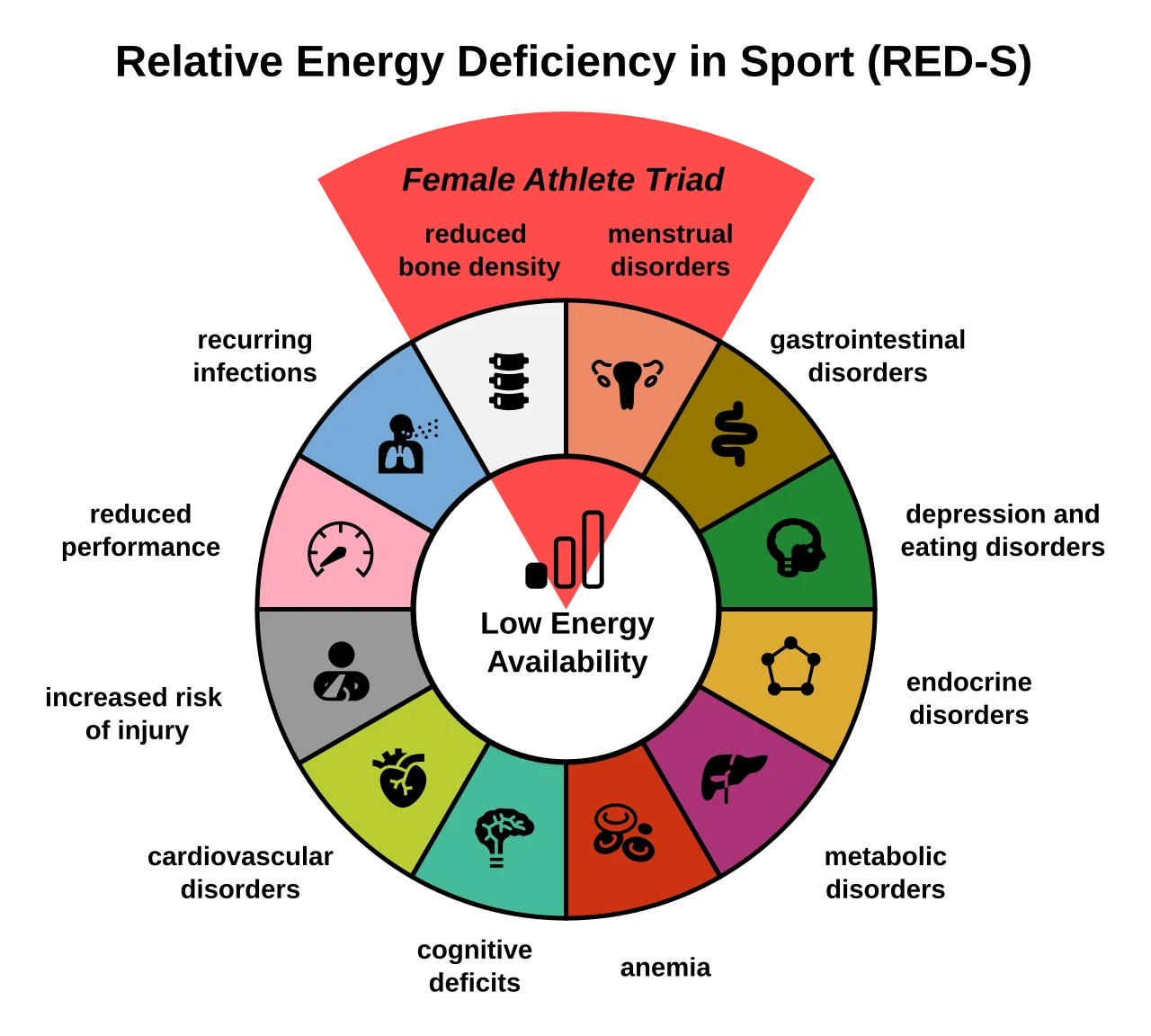
Physical signs
- Missed, irregular, or absent periods
- In male athletes, lower sex drive or other signs of reduced testosterone
- Stress fractures, or injuries that keep coming back
- Getting sick more often than usual
- Fatigue or dizziness
- Training harder but getting slower, or not recovering between sessions
Mental and emotional signs
- Trouble concentrating, slower reactions, or poorer coordination
- Irritability, low mood, or anxiety around food
- Skipped meals and rigid food rules
Mental health is part of this picture in both directions. According to the IOC, mental health concerns can come before RED-S or result from it.
Why RED-S gets missed in athletes
Athletes are very good at pushing through. You were coached to. So fatigue gets called a bad week, a stress fracture gets called bad luck, and a missed period gets called normal for a distance runner. It is common in some sports, but it is not something to ignore. It is information.
I was a competitive swimmer for years, and I can recall moments in my own career that reinforced the idea that thinner is better for performance. Weight is one factor among many in performance, and it is the one that raises the risk of an eating disorder.
What helps with RED-S
The main treatment is simple to describe, even when it is hard to do: restoring enough energy for the training you are doing. The IOC's primary recommendation is to change food and training so the body has what it needs again.
It also works best as a team effort: sports medicine, nutrition, and psychology, with coaches and family involved. The IOC says that team matters most when RED-S is tied to disordered eating or an eating disorder. A dietitian can help you know what to eat. Part of my job is helping with everything that makes eating it hard: the fear of slowing down, the guilt on rest days, the voice that says you have not earned it yet. It often comes up in sport psychology work, too.
If you had a stress fracture, you would not question whether it deserved a doctor. Underfueling deserves the same care.
For parents and coaches
If you are a parent or a coach, lead with what you have noticed rather than with food or weight. Listen without judgment, and involve the athlete's physician. ANAD's guide to athletes and eating disorders is a good starting point. I also run learning sessions for teams, coaches, and parents on exactly this.
A note before you go
This post is for education, not diagnosis. If something here sounds familiar, start with a physician, ideally one who works with athletes, and consider adding a dietitian and a therapist who understands sport.
If you are in crisis or thinking about harming yourself, call or text 988 to reach the 988 Suicide and Crisis Lifeline, any time of day.
If you would like to talk it through with me, read about my eating disorder therapy for athletes, or see whether we are the right fit with a free 15 minute consultation, in person in Jacksonville or by telehealth. You do not have to be sure it is RED-S to ask. An athlete is a person first.
Sources
- Mountjoy M, Ackerman KE, Bailey DM, et al. 2023 International Olympic Committee's (IOC) consensus statement on Relative Energy Deficiency in Sport (REDs). British Journal of Sports Medicine. 2023;57(17):1073–1097. doi.org/10.1136/bjsports-2023-106994
- National Association of Anorexia Nervosa and Associated Disorders (ANAD). Athletes and Eating Disorders
- 988 Suicide and Crisis Lifeline